
Lawn
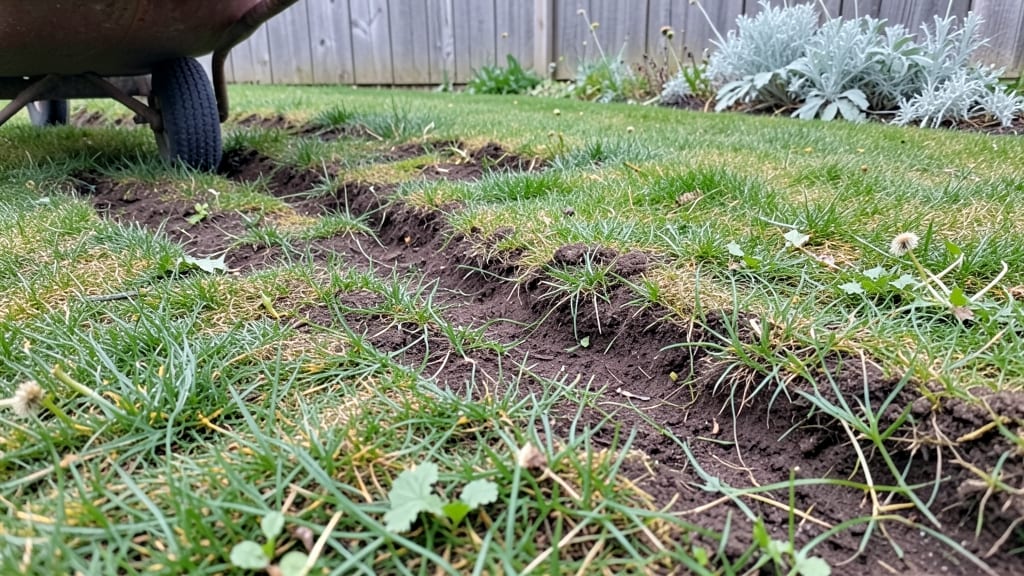
Grass recovery depends heavily on your lawn's health and soil conditions. Kentucky bluegrass and tall fescue bounce back faster due to their dense root systems, while Bermuda grass may struggle in compacted areas.
The key is breaking up that compaction—aeration lets roots breathe, and topdressing with sand helps fill low spots naturally. I’ve seen ruts disappear in 3-6 months with consistent care, but deeper grooves might need professional leveling. 🌱
For stubborn ruts, timing matters: aerate in spring or fall when grass is actively growing, then overseed to thicken the lawn. Water deeply 2-3 times per week afterward to encourage root growth.
If the rut is more than 1 inch deep, consider a mix of sand and compost for gradual leveling—this prevents soil erosion while giving grass a chance to fill in gaps.
💡 In This Article
- How Grass Types and Soil Conditions Affect Rut Recovery
- Step-by-Step Lawn Repair for Stubborn Tire Ruts
How grass types and soil conditions affect rut recovery
The recovery speed of tire ruts depends entirely on your grass type's root strength and soil's ability to support regrowth. Cool-season grasses like Kentucky bluegrass and tall fescue have dense, fibrous root systems that spread aggressively—ideal for filling compacted areas.
Their roots can grow up to 6-12 inches deep, allowing them to penetrate and stabilize soil better than shallow-rooted varieties. Warm-season grasses like Bermuda grass, however, struggle with compaction because their roots grow more horizontally, creating a weaker structural network.
Soil composition plays a critical role too. Sandy soils drain quickly but lack moisture retention, which can stunt root growth in ruts. Clay-heavy soils, while better at holding water, become rock-hard when compacted, suffocating grass roots.
The ideal balance is loamy soil with 25-50% organic matter, which provides both drainage and moisture retention. In compacted areas, the soil's porosity drops by 30-50%, restricting oxygen flow—this is why aeration is so crucial for recovery.
Here's what's actually happening at the root level: When grass blades are crushed by tires, the soil beneath becomes compressed, reducing pore space for air and water. Kentucky bluegrass recovers fastest because its roots can regenerate from the crown (the base where leaves meet roots), while ryegrass relies on seed germination for repair.
The recovery timeline varies: shallow ruts (½ inch deep) may heal in 3-4 months, while deeper grooves can take 1-2 years without intervention.
Moisture retention becomes the deciding factor in recovery speed. Compacted soil repels water, creating dry pockets where grass can't establish. This is why topdressing with sand (about ¼ inch thick) works—it improves soil structure by increasing pore space.
The sand's coarse texture also prevents further compaction from foot traffic or tires. For clay soils, mixing in compost (about 10% by volume) helps break up the dense particles while adding nutrients for faster regrowth.
Temperature also affects recovery rates. Cool-season grasses grow most actively between 60-75°F, while warm-season varieties thrive at 80-95°F. This means spring and fall are the best times for repair in most climates.
During these periods, grass can grow ½ inch per week under ideal conditions, which is why overseeding after aeration gives you the fastest results. The key is patience—even with perfect care, complete rut disappearance can take 6-12 months depending on grass type and soil conditions.
What most people don't realize is how soil microbes contribute to recovery. Healthy soil contains billions of beneficial bacteria and fungi that break down organic matter, creating channels for roots to follow. When soil is compacted, these microbes become less active, slowing down the natural healing process.
Adding mycorrhizal fungi (available in some lawn starters) can accelerate root growth by forming symbiotic relationships with grass roots, effectively creating a "highway system" for nutrients and water to reach damaged areas.