
Lawn
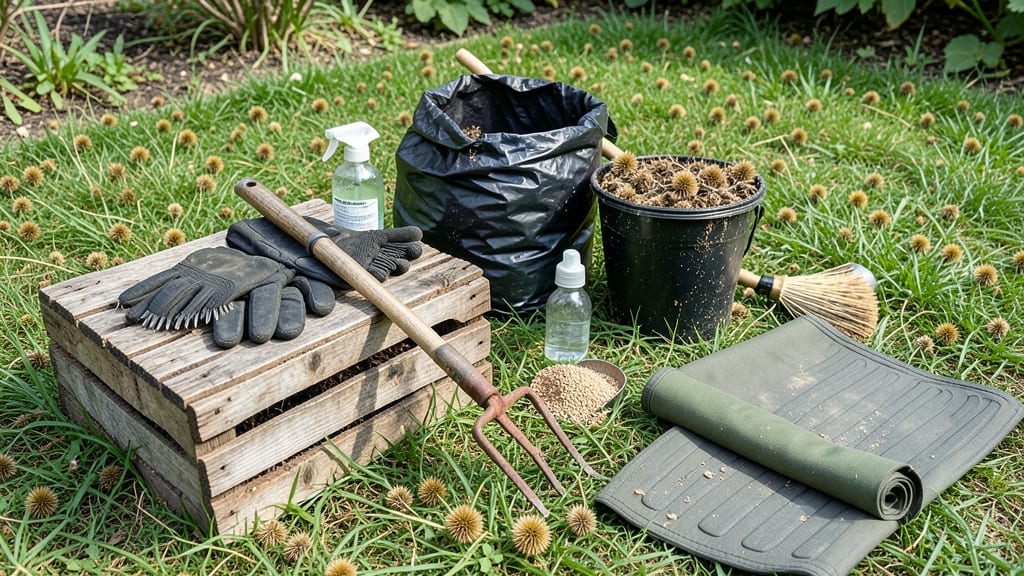
To get rid of burrs in lawn, pull young plants by hand, use a string trimmer for dense clusters, or apply vinegar or herbicide for deep-rooted infestations. Always remove them before they mature to stop seed dispersal.
Burrs thrive because their seeds cling to everything, spreading rapidly across lawns.
These tough weeds develop deep root systems that compete with grass for water and nutrients, making them harder to eliminate once established. 🌱 The key to control is acting fast—young burrs pull out easily by hand, while mature plants require heavier tools or chemical solutions.
I've found that vinegar works well for spot treatments, but for large areas, a targeted herbicide gives more consistent results.
For best outcomes, check your lawn weekly during growing season. Burrs often appear after mowing or when grass is stressed, so keeping your lawn healthy reduces their chances of taking over. 💛 Early intervention saves time and prevents those painful seed pods from sticking to pets and shoes!
💡 In This Article
- Why Burrs Spread So Quickly in Lawns
- Manual vs. Machine Burr Removal: Pros and Cons
Why burrs spread so quickly in lawns
Burrs dominate lawns because their lifecycle is designed for rapid colonization.
Each seed pod contains hundreds of barbed seeds that cling to clothing, pet fur, and even lawn tools, creating a mobile army of invaders. 🌱 When these seeds land in grass, they germinate within 7-14 days—faster than many grass types regrow after mowing.
The plants develop deep taproots (often 12-18 inches long) that tap into water and nutrients before grass can recover, giving them a competitive edge.
The real problem starts when burrs reach maturity. Their spiky seed pods form 4-6 weeks after germination, and a single plant can produce 500-1,000 seeds that remain viable for 5-10 years in soil.
This explains why you might see new burrs appear even after removal—the dormant seed bank in your lawn keeps replenishing the population. The longer you wait to act, the more seeds you're adding to this underground reservoir.
Burrs also outcompete grass through aggressive growth habits.
Their broad leaves (up to 3 inches wide) shade out grass seedlings, while their deep roots create zones of poor grass growth. 💛 In drought conditions, burrs actually thrive while grass goes dormant, making them harder to spot until they've already established themselves.
This is why preventive maintenance—like regular mowing at 3-4 inches—helps by keeping grass dense enough to block light from reaching burr seeds.
Another critical factor is how burrs respond to disturbance. When you mow or till, you're actually helping them by breaking their seed pods open and scattering new seeds.
This is why many lawn care experts recommend avoiding heavy tilling if burrs are present—it can turn a small problem into a full-blown invasion overnight. The solution? Target removal before seeds mature, and use tools that minimize soil disruption.
What most people don't realize is how burrs exploit lawn weaknesses.
They thrive in compacted soil where grass struggles, and their seeds often hitchhike into yards on garden equipment or shoes. 🌟 A single visit from a neighbor's dog walking through a burr-infested area can introduce thousands of seeds to your lawn.
This is why containment is key—treating burrs early prevents them from becoming a neighborhood-wide problem.
Understanding this lifecycle explains why timing matters so much. Young burrs (under 4 inches tall) pull out easily by hand, while mature plants require more aggressive methods. The window for effective control is narrow—typically 30-45 days after germination—after which the plants become much harder to remove without chemicals.
This biological clock is what makes burrs such persistent lawn pests.