
Watering
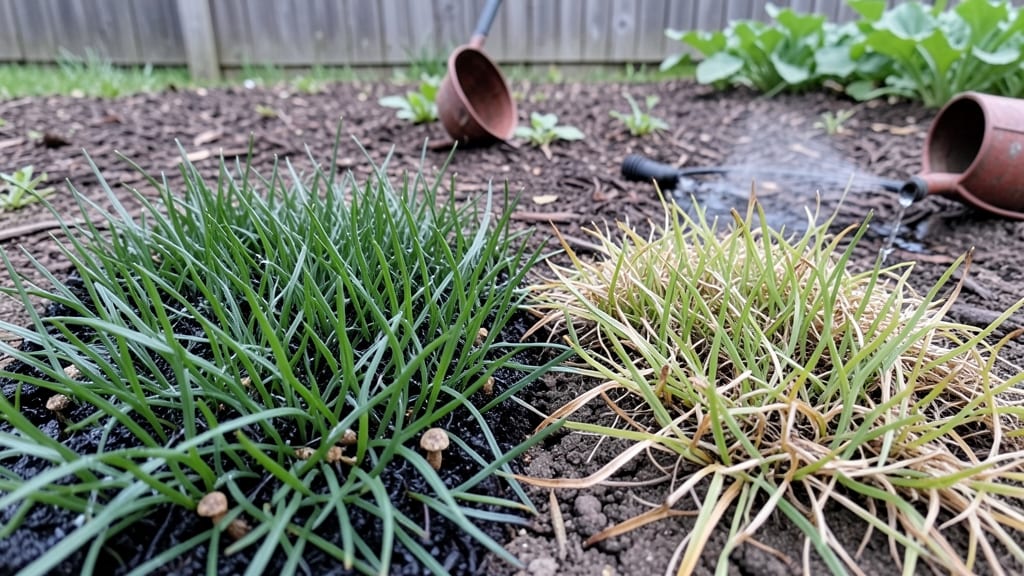
To tell if grass is overwatered or underwatered, examine its color and texture—dark green with a mushy feel indicates excess water, while yellowing, brittle patches, or grass pulling up easily shows drought stress. Test soil moisture and root health to diagnose properly and adjust your watering schedule accordingly.
Your lawn's water needs aren't just about how much you pour—it's about how the grass responds.
Overwatered turf often smells musty or develops that telltale soggy feel when you walk on it, while underwatered grass feels dry and brittle, almost like straw. 💧 I've learned the hard way that both extremes create ideal conditions for fungal diseases—overwatering breeds mold, while drought weakens roots.
The key is checking soil moisture at the root level (about 2-3 inches down) rather than just the surface, since that's where the real story happens.
Here's a pro tip: grab a handful of soil—if it crumbles easily, your grass likely needs water. If it sticks together like wet sand, you're overdoing it. I always carry a small trowel in my gardening belt for quick soil checks between watering sessions.
The roots themselves tell the full story: healthy roots should be white and firm, while waterlogged roots turn gray and mushy, or dry and shriveled when underwatered.
💡 In This Article
- Grass Color and Texture Clues for Water Stress
- Soil and Root Tests for Accurate Diagnosis
Grass color and texture clues for water stress
When grass struggles with water, it sends visual distress signals through color changes tied to photosynthesis disruption. Overwatering triggers chlorosis—a yellowing between leaf veins—because roots can't absorb oxygen in waterlogged soil.
This creates iron deficiency as the plant starves for nutrients, while underwatering causes necrosis (brown, crispy patches) from cell dehydration. The difference? Chlorosis appears uniformly pale, while necrosis shows as dead, brittle spots that crumble when touched.
Texture reveals the root cause literally. Overwatered grass feels spongy when walked on, almost like a wet carpet, because cell walls break down from excess moisture. You might even see mold (white or gray fuzzy growth) in shaded areas where humidity lingers.
Underwatered grass, however, feels dry and papery, with blades that snap easily—like walking on straw. The smell differs too: overwatered turf has a musty, earthy odor from anaerobic bacteria, while drought-stressed grass smells stale and crisp.
The science gets interesting at the root level. Grass roots need oxygen to respire—when soil stays saturated for 48+ hours, roots suffocate and turn grayish-brown. This triggers ethylene gas production, accelerating decay. Underwatered roots, meanwhile, shrink and pull away from soil particles, making them easily detachable when tugged.
Both extremes weaken the root system's ability to anchor the plant, which is why overwatered grass often pulls up with minimal resistance.
Fungal growth is the ultimate red flag for overwatering. Pathogens like Fusarium and Rhizoctonia thrive in wet conditions, creating circular patches of discolored grass. These fungi block water uptake, making the problem self-perpetuating.
Underwatering, while less dramatic visually, creates stress cracks in roots that make them vulnerable to drought—think of it like a hose left unwatered until it splits. Both scenarios create a feedback loop where the grass's ability to recover diminishes with each cycle of imbalance.
Here's what most people miss: the timing of symptoms matters. Overwatering signs appear within 24-72 hours of excess moisture, while underwatering takes 3-7 days to show visible damage. This is why checking soil moisture at 2-3 inches deep (where most roots live) gives a truer picture than surface checks.
A simple finger test—pushing your finger into the soil—can tell you if it's holding too much water (sticks to your finger) or too little (falls apart like dust).
For a hands-on comparison, try this: walk across your lawn barefoot. Overwatered grass will feel squishy underfoot, almost like a waterbed, while underwatered grass will feel springy and resist pressure. The texture difference is night-and-day—one feels like a swamp, the other like walking on a dry, brittle mat.
This tactile test works better than visuals alone because it accounts for both moisture and structural integrity of the grass blades.