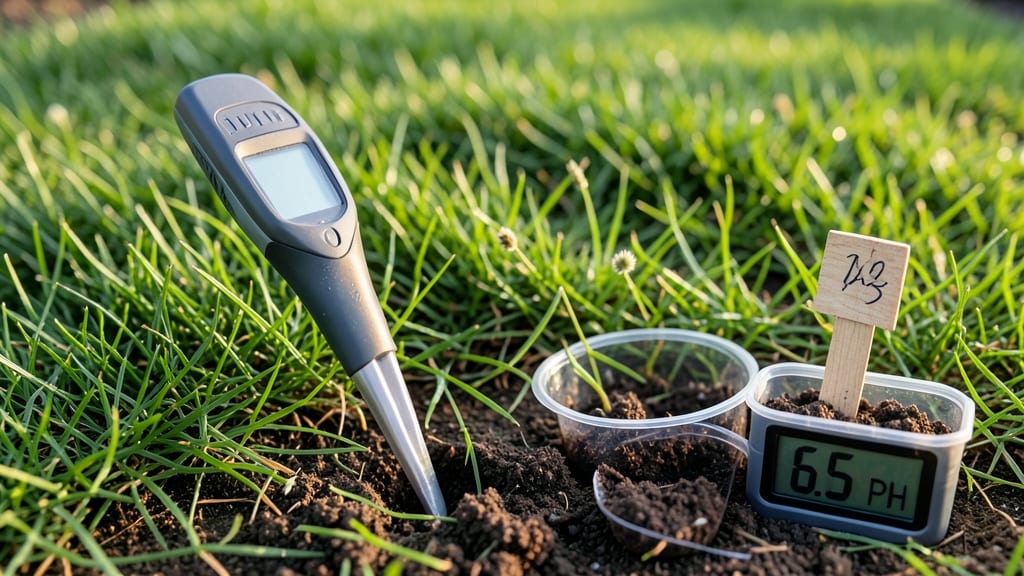
Buying guide: how to choose the right lawn pH tester
1. Test Type: Digital vs. Analog vs. Test Strips 💡
Not all lawn pH testers are created equal—your choice depends on your needs. Digital meters offer the most precise readings (down to 0.01 pH) and are ideal for serious gardeners who need professional-grade accuracy. Test strips provide quick, portable results but sacrifice precision (±1 pH), making them perfect for casual users or large lawns where multiple tests are needed. Analog testers (like pH pens) strike a balance, offering reusable probes with moderate accuracy (±0.2 pH) at a mid-range price.
Counter-intuitively, test strips are the fastest for broad surveys, while digital meters excel for targeted adjustments. If you’re dealing with acid-loving plants like blueberries or alkaline-tolerant grasses like Bermuda, precision matters—so digital wins. For general lawn health, a test kit offers the best value.
2. Measurement Range and Precision ⚡
The ideal pH range for most lawns is 6.0–7.0, but some grasses thrive outside this zone (e.g., fescue prefers 5.5–6.5).
Look for a tester covering 0–14 pH to handle all soil types. Precision matters: Digital meters with 0.01 increments are best for fine-tuning, while test strips (typically ±1 pH) are sufficient for rough estimates. Analog testers usually offer 0.1–0.2 increments, striking a balance.
Pro tip: If you’re testing for specific plants (e.g., azaleas need 4.5–5.5 pH), prioritize a tester with narrow-range accuracy. For general lawn care, ±0.5 pH is acceptable, but digital meters deliver peace of mind.
3. Ease of Use and Calibration Requirements ✅
Calibration is critical—even the best tester will drift over time. Digital meters often require two-point calibration (using pH 4.0 and 7.0 solutions), while analog testers may need occasional recalibration. Test strips and test kits are calibration-free but rely on fresh reagents. Look for models with auto-off features (to save battery) and waterproof probes (for outdoor use).
In my experience, digital meters with built-in calibration solutions save time, while test kits require more prep (mixing soil/water samples). If you’re testing multiple spots, a portable, easy-to-clean probe (like a pH pen) is a game-changer.
4. Additional Features: EC/TDS, Temperature Compensation, and Waterproofing 🔍
Beyond pH, advanced testers measure EC (electrical conductivity) and TDS (total dissolved solids), which indicate soil fertility. These features are overkill for basic lawn care but invaluable for vegetable gardens or high-maintenance turf. Temperature compensation adjusts readings for accuracy in hot/cold soil, while waterproofing extends probe lifespan.
If you’re on a budget, skip these extras—but invest in them if you’re serious about precision farming.
For most lawns, a basic pH meter with temperature compensation is sufficient. However, if you’re dealing with sandy soil (low nutrient retention) or clay soil (high salinity), a 3-in-1 meter (pH + EC + TDS) reveals hidden issues like nutrient lockout or compaction.
5. Budget Considerations 💰
Budget-friendly test strips start at entry-level pricing and are perfect for quick checks or large lawns. Mid-range digital meters (with calibration) offer the best balance of accuracy and affordability, while premium 3-in-1 meters are a significant investment for advanced users. If you’re unsure, start with a test kit—it’s the most cost-effective way to test multiple spots before committing to a digital meter.
Remember: A cheap tester with poor accuracy can lead to over-fertilization or wasted amendments. Invest in a reliable, calibrated tool to avoid costly mistakes.
Frequently asked questions
Q: What is the ideal pH range for a healthy lawn, and why does it matter?
The ideal pH range for most lawns is 6.0–7.0, where grass can efficiently absorb essential nutrients like nitrogen, phosphorus, and potassium. Soil that’s too acidic (below 6.0) or too alkaline (above 7.5) locks out nutrients, leading to weak growth, yellowing grass, or increased weeds. For example, fescue thrives at 5.5–6.5, while Bermuda grass tolerates 6.0–7.5. Testing with a lawn pH tester helps you amend soil with lime (to raise pH) or sulfur (to lower pH), restoring balance for lush, vibrant grass.
Q: Can I use a lawn pH tester on different types of soil (clay, sandy, loamy)?
Yes, but soil type affects testing accuracy. For clay soil, mix a 1:1 ratio of soil to distilled water and let it settle before testing to avoid compacted particles skewing results. Sandy soil drains quickly, so test immediately after mixing. Loamy soil (ideal for lawns) requires minimal prep—just follow the tester’s instructions. Digital meters with temperature compensation handle variations better than test strips. For precise results, calibrate your tester before use, especially in extreme soil conditions.
Q: Why are my pH test results inconsistent, even with the same tester?
Inconsistent results usually stem from poor calibration, contaminated probes, or improper sample prep. Always rinse the probe with distilled water between tests and recalibrate (for digital meters) every 3–6 months or after 50+ uses. Avoid testing in recently fertilized or wet soil, as chemicals or moisture can alter pH readings. For test strips, store them in a cool, dry place and use them within the expiration date. If readings still vary, try a different tester—some budget models lack precision.
Q: What’s the difference between a digital pH meter, test strips, and a soil test kit?
1
Digital pH meters
offer 0.01 precision (ideal for fine-tuning) but require calibration and cost more. Test strips provide instant, portable results (±1 pH) at budget-friendly pricing, perfect for quick checks or large lawns. Soil test kits (like the 100-test comparator) deliver professional accuracy (±0.5 pH) with reusable reagents, striking a balance between cost and reliability. Choose digital for exact adjustments, strips for speed, and kits for bulk testing without lab costs.
Q: How often should I test my lawn’s pH, and when is the best time?
Test your lawn’s pH every 6–12 months or when you notice patchy growth, discoloration, or weed outbreaks. The best time to test is early spring (before fertilizing) or fall (after mowing season) when soil is stable. Avoid testing after heavy rain, fertilizer application, or drought, as these events temporarily alter pH. For new lawns, test 3–6 months after seeding to ensure proper establishment. Regular testing helps you adjust soil proactively rather than reactively.
Q: Is a budget-friendly pH tester worth it, or should I invest in a mid-range or premium model?
A budget-friendly tester (like test strips) is great for casual users or large lawns needing quick checks, but it lacks precision (±1 pH). A mid-range digital meter (with 0.01 precision and calibration) is the best investment for serious gardeners—it ensures accurate adjustments and lasts years. Premium models (with EC/TDS features) are overkill for lawns but ideal for vegetable gardens or high-maintenance turf. If you’re unsure, start with a test kit (like the 100-test comparator) to identify hotspots before upgrading.
Q: How do I adjust my lawn’s pH if the test shows it’s too high or too low?
For high pH (alkaline soil), apply pelletized lime (calcium carbonate) to raise pH gradually. For low pH (acidic soil), use elemental sulfur or iron sulfate. Follow the tester’s adjustment guide for application rates—typically 50–100 lbs of lime per 1,000 sq ft for severe alkalinity or 20–40 lbs of sulfur per 1,000 sq ft for acidity. Retest in 2–3 months and reapply as needed. Avoid over-amending, as drastic pH shifts can harm grass roots. For organic options, try wood ash (to raise pH) or pine needles (to lower pH).